Project
Jjagɨyɨ: Air of Life








Jagɨyɨ: Air of Life
PPOW Gallery, New York
September 8 - October 7, 2023
SEMBRAR LA DUDA: Indicios sobre la representación Indígena en Colombia
Museo de Arte Miguel Urrutia (MAMU), Bogotá
October 7, 2023 - April 15, 2024
Jagɨyɨ: Air of Life, a work from Carlos Motta with Elio Miraña, ELO, Gil Farekatde Maribba, Higinio Bautista, Kiyedekago, Rosita, and Yoí nanegü, builds on Motta’s two-decade history of collaborative multi-media installations that examine identities and lived-experiences of marginalized groups, and the intersectional repercussions of colonialism.
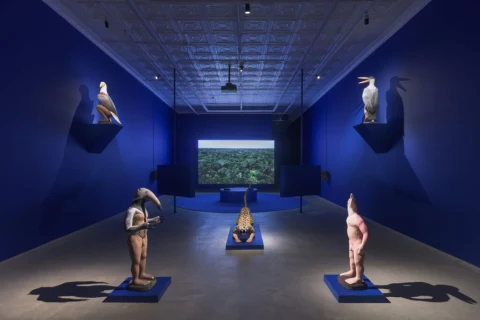
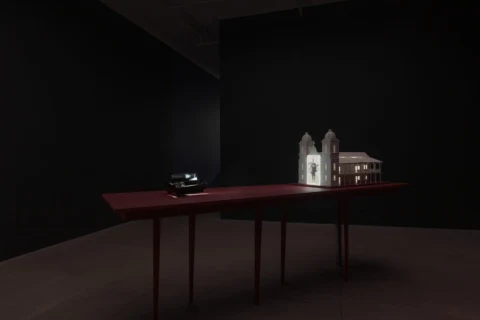
Through a sustained engagement with cultural practitioners from Indigenous groups in the Colombian Amazon like the Maguta, Miraña, Muinane, and Murui, Motta and his collaborators confront the colonialist history of boarding schools established in the region by the Capuchin Missions and their lasting impact on the disuse of Indigenous languages, the truncated transmission of cultural knowledges, and the establishment of Christianity as an institutionalized religion. The concept of ‘jjagɨyɨ,’ in the Murui language, is an origin story that is also shared by a cultural complex of eight ethnic groups known as ‘the people of the center of the world,’ and interpreted as the ‘children of a Creator.’ Jjagɨyɨ: Air of Life thus invokes resuscitating or breathing life back into ancestral cultural practices in the present. Consisting of multi-media work, the exhibition features a video played across three screens, wood sculptures, and a paper and cardboard model as a symbol of the erasure of culture.
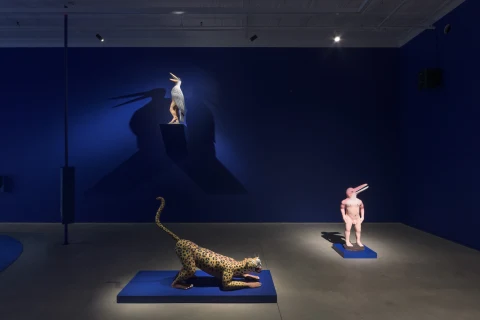
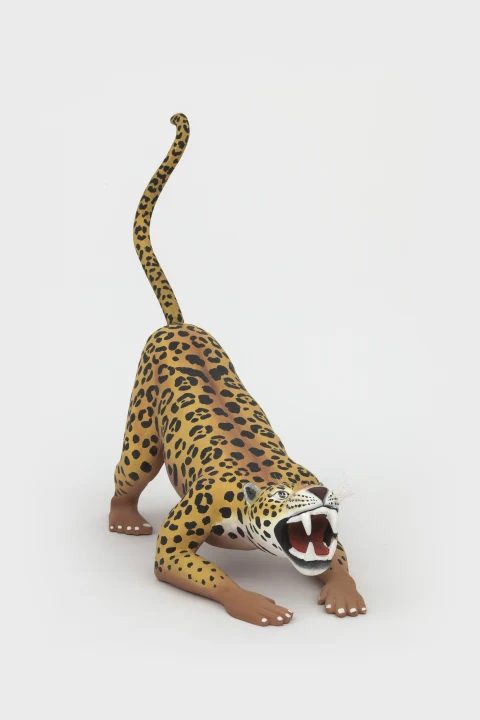
Entering the first room, there are six wooden sculptures displayed. Shaman Tiger, Shaman Anteater, Shaman Eagle, Shaman Boa, Shaman Heron, and Shaman Dolphin (all 2023) create a frame not just for the space but also for the problems explored through the exhibition. Designed and created in Tabatinga, Brazil with Maguta artisan Higinio Bautista, the pieces depict a legend, where shamans undergo physical body transformations into animals that protect the people and the land they inhabit. Their positioning at the periphery echoes the protection they provide, necessitating a negotiation with the sculptures before entering the place where knowledge is transmitted and shared.
The central piece in the room, sharing its name with that of the exhibition, Jjagɨyɨ: Air of Life, 2023, is a 3-channel video installation, simultaneously playing on a projector and two monitors. In the videos shown, the collaborators recount their experiences after the arrival of the Catalan monks of the Capuchin Order, a push-and-pull struggle that continues to affect them. The histories of Indigeneity coalesce through the voices depicting the infliction of violence, both verbal and physical. Through their storytelling, artisanship, dance, and song, the speakers participate in the protection and survival of their language and practices. The video features Elio Miraña, Gil Farekatde Maribba, Higinio Bautista, Kiyedekago, Rosita, and Yoí nanegü who speak of how their upbringing reflected traditionality, yet upon their entry into the boarding schools and other modern colonial institutions, they were forced to assimilate into Catholicism, speak Spanish, and adopt Western social norms and expectations. The sporadic Indigenous words that they speak in their sentences are a gesture to both what no longer exists and what could potentially be rescued. As is warned by Elio Miraña, ‘a lot can be lost, but once we lose our language, we lose everything.’
The main viewing room offers both a visual and sonic experience. Interspersed throughout, shots of the Amazonian landscape are a reminder of the magnitude of the forest and the indigenous histories housed within its lush and green terrain. They also allude to the use of trees in the creation of sculptures like those by Higinio Bautista and the spirits that reside in them, having to be blessed by a shaman before being cut down. Accompanying the visual imagery of the videos, the vastness of the Amazon, and its constant noises made by insects, animals, and plant life are replicated in the soundtrack composed by ELO and soundscapes by field sound recorder and designer Isabel Torres, which aid in the atmospheric transformation of the gallery. Together with the sculptures, the layered components of the work in the first room highlight the viewer’s status as a guest, posing the question of how they may engage with the space.
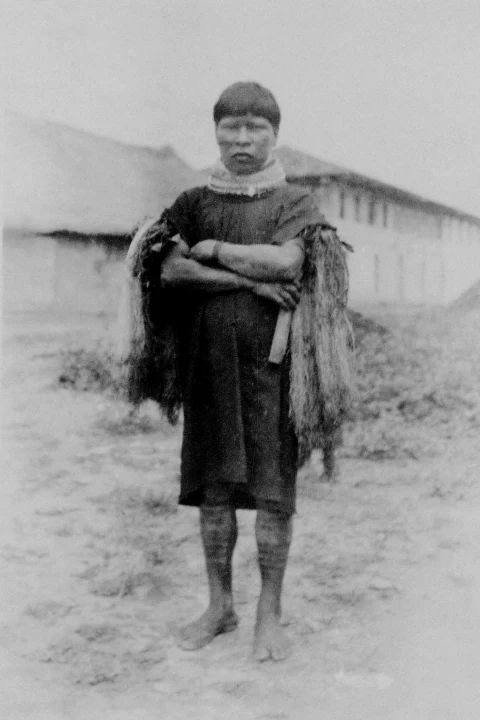
The exhibition culminates in the back room, where displayed is The Capuchin Order, 2023, a hybrid sculpture made from paper and cardboard depicting La Casa Arana and a colonial Catholic church. Projected onto the model are 35mm slide photographs taken by the missionaries, bringing to life the long history of the missions and the complex role the Capuchin monks played in the colonial Amazon. The house was built by owners of the Peruvian Amazon Company, brothers Julio Cesar and Lizardo Arana, in La Chorrera, Amazonas in the late 19th century. Needing individuals to provide labor in the sourcing and production of rubber, the Arana brothers enlisted methods utilized by enslavers to kidnap Indigenous men, women, and children. Forced to work to exhaustion, they were severely punished if they did not, as Rosita recalls in the video, meet the quota of rubber extraction. This led to the death of thousands of Indigenous individuals, who, with their fatal demise, took stories and knowledge. This dark episode in the region’s history is known as the second Indigenous genocide in the Amazon after the Conquest. To merge the house and the church is an apt reminder of the relationship between the colonizers and missionaries of the past and the lasting blemish left on Indigenous groups.
